Blog
The Rise of WooCommerce in Japan’s E-commerce Market

Japan boasts one of the largest and most sophisticated e-commerce markets globally. For years, domestic powerhouses like Rakuten and Yahoo! Shopping dominated the landscape, alongside localized platforms such as BASE and STORES. These marketplaces provided a comfortable, familiar environment for local consumers.
Recently, a significant shift has occurred among Japanese merchants. Independent brands and small-to-medium enterprises are seeking greater control over their online presence. They want flexibility, lower overhead costs, and the ability to scale globally. This search for independence has led many to a surprisingly popular solution: WooCommerce.
WooCommerce is an open-source e-commerce plugin built for WordPress. While it has enjoyed massive popularity in Western markets for over a decade, its adoption in Japan was historically slower due to language barriers and a preference for domestic software. Now, the tide is turning. Japanese developers and store owners are embracing the platform at an unprecedented rate.
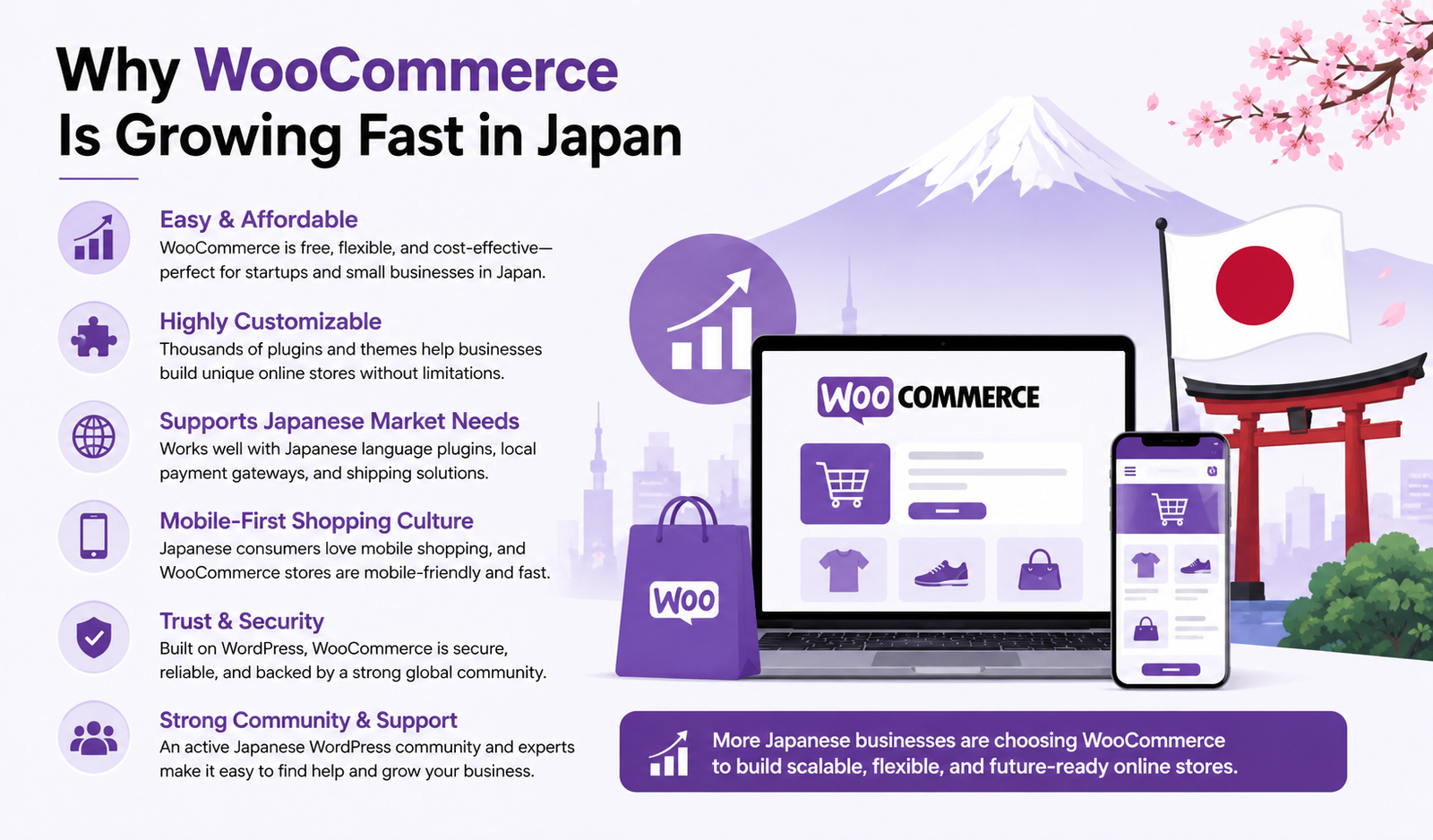
Understanding why WooCommerce is growing fast in Japan requires a close look at the evolving needs of Japanese merchants, the improvements in localization, and the platform’s unmatched flexibility.
The Changing Needs of Japanese Merchants
Selling on major digital marketplaces guarantees heavy foot traffic. Millions of Japanese consumers log into Rakuten daily, making it an attractive starting point for new businesses. However, this visibility comes with steep operational costs and strict platform rules.
Breaking Free from Marketplace Constraints
Marketplaces charge significant commission fees on every sale, alongside monthly hosting costs. They also limit how a brand can present itself. Storefronts often look identical, making it difficult for unique brands to stand out. Furthermore, marketplaces retain ownership of customer data, preventing merchants from building direct relationships with their buyers.
Merchants are realizing that to build a sustainable, long-term brand, they need their own standalone websites. They require access to their customer data to run targeted email campaigns and build loyalty programs. WooCommerce provides this exact infrastructure, granting complete ownership of both the store and the data it generates.
The Desire for Brand Control
A customized user experience is vital for premium and niche brands. Store owners want to control the exact layout, color scheme, and checkout flow of their websites. Because WooCommerce is built on WordPress, it offers nearly limitless design possibilities. Merchants can choose from thousands of themes or hire a developer to build a completely bespoke digital storefront. This level of customization is largely absent from localized, beginner-friendly platforms.
Key Factors Driving WooCommerce Adoption
The transition toward independent online stores partly explains the rise of Shopify and WooCommerce. Yet, WooCommerce has specific advantages that make it highly appealing to the Japanese market.
Cost-Effective Scaling
Starting a business requires careful financial planning. Many hosted e-commerce platforms charge monthly subscription fees that increase as the store grows or requires advanced features. WooCommerce is an open-source plugin, meaning the core software is completely free.
Merchants only pay for their web hosting, domain name, and any premium plugins they choose to add. For a small Japanese business testing the waters of independent online retail, this low barrier to entry is highly attractive. As revenue grows, the store can scale its server capacity without being forced into a higher software subscription tier.
Seamless WordPress Integration
WordPress is immensely popular in Japan. Many businesses already use WordPress to host their corporate websites and blogs. Adding an online store to an existing WordPress site is much easier than building an entirely new website on a different e-commerce platform. WooCommerce integrates seamlessly into the WordPress dashboard, allowing staff to manage blog content and product inventory from the exact same interface.
The Expanding Ecosystem of Japanese Plugins
Historically, setting up a WooCommerce store in Japan required complex coding to handle local requirements. That is no longer the case. A robust community of Japanese developers has built a wide array of specialized plugins.
Store owners can easily add functionalities specific to the local market. This includes plugins that format addresses correctly for Japanese shipping companies like Yamato Transport and Sagawa Express. Other tools automate the generation of Japanese invoices and receipts, which must adhere to specific formatting rules for tax purposes.
Overcoming Language and Localization Barriers
The initial hesitation toward WooCommerce in Japan stemmed from localization issues. Software developed in English does not always translate well into Japanese due to differences in text direction, character spacing, and cultural expectations regarding web design.
Native Translation and Community Support
The WordPress translation community in Japan is highly active. The core WooCommerce plugin is now fully translated into natural-sounding Japanese. Beyond the software itself, there is a wealth of tutorials, forums, and documentation available in Japanese. When a store owner encounters a problem, they can easily find solutions without needing to navigate English-language forums.
Integrating Local Payment Gateways
Payment preferences vary drastically by region. While credit cards are popular in Japan, many consumers prefer local payment methods. “Konbini” (convenience store) payments, Pay-easy, and local mobile payment apps like PayPay are essential for maximizing conversion rates.
In the past, connecting these local payment gateways to a foreign platform was difficult. Today, major Japanese payment processors offer official WooCommerce integration plugins. Merchants can securely accept credit cards alongside domestic payment methods, ensuring a frictionless checkout experience for local buyers.
Comparing WooCommerce to Local Alternatives
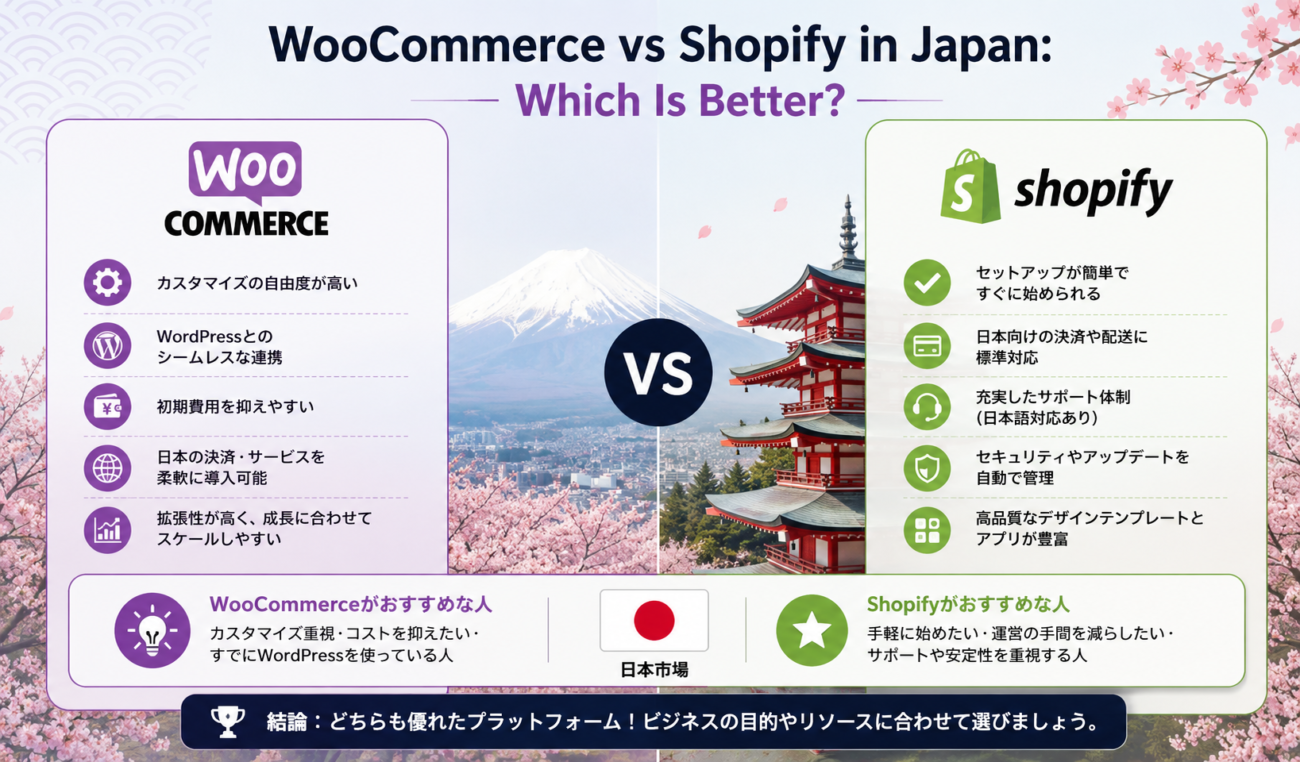
When Japanese merchants evaluate their options for building a standalone store, they often compare WooCommerce to domestic SaaS (Software as a Service) platforms like BASE or STORES.
BASE and STORES are incredibly easy to set up, making them excellent choices for hobbyists or very small businesses. However, they operate on a revenue-share model or charge monthly fees for advanced features. Their SEO capabilities and design customization options are also somewhat limited.
WooCommerce requires a slightly steeper learning curve. The store owner is responsible for managing updates and securing their hosting environment. The trade-off is absolute freedom. There are no restrictions on the number of products, no mandatory platform transaction fees, and complete control over technical SEO structures. For businesses focused on aggressive growth, the flexibility of WooCommerce far outweighs the initial setup effort.
Frequently Asked Questions (FAQ)
Is WooCommerce completely free to use in Japan?
The core WooCommerce software is free to download and use. However, you will need to pay for web hosting, a domain name, and potentially premium plugins for specific local payment gateways or shipping integrations.
Can WooCommerce handle Japanese shipping methods?
Yes. There are dedicated plugins developed for the Japanese market that integrate with major domestic carriers like Yamato Transport (Kuroneko) and Japan Post. These plugins allow you to print appropriate shipping labels and calculate accurate rates based on local prefectures.
How does WooCommerce handle Japanese taxes?
WooCommerce has built-in tax calculation settings that can be configured for Japan’s consumption tax. Additionally, specialized plugins can ensure your receipts and invoices comply with the latest Japanese invoicing regulations.
Is it difficult to translate a WooCommerce store?
If your goal is to sell domestically, the backend and frontend of WooCommerce are already translated into Japanese. If you want to run a multilingual store to sell globally, plugins like WPML or Polylang make it easy to translate your product pages into multiple languages.
Start Building Your Global Japanese Brand
The rapid growth of WooCommerce in Japan highlights a broader trend in global digital commerce. Merchants are prioritizing ownership, flexibility, and scalability. By moving away from restrictive marketplaces and closed-ecosystem platforms, Japanese businesses are taking control of their digital destinies.
WooCommerce provides the necessary tools to build a highly customized, localized shopping experience. With a thriving ecosystem of local developers and seamless integration with domestic payment and shipping providers, the platform is perfectly positioned to support the next generation of Japanese online retail. If you are preparing to launch or migrate an online store, exploring the open-source possibilities of WooCommerce is an excellent strategic move.