Blog
Shopify vs WooCommerce in Japan: Which is Better?

Japan represents one of the most lucrative e-commerce markets globally. Expanding your business to this region offers massive revenue potential, provided you choose the right digital infrastructure. For most merchants, the decision ultimately comes down to two heavyweights: Shopify and WooCommerce.
Selecting an e-commerce platform for the Japanese market requires more than simply translating your website. Japanese consumers have unique expectations regarding site navigation, customer service, shipping options, and payment methods. A platform that works flawlessly in North America or Europe might struggle to convert shoppers in Tokyo or Osaka without the right localized features.
This guide explores how Shopify and WooCommerce stack up when tailored for Japanese consumers. We will compare their localization capabilities, payment integrations, ease of use, and overall costs to help you determine which platform aligns best with your business goals.
Understanding the Japanese E-commerce Landscape
Before evaluating specific platforms, you must understand how Japanese consumers shop online. Trust and credibility are paramount. Shoppers expect highly detailed product descriptions, high-quality images, and transparent company information. If a website appears poorly translated or lacks familiar local payment options, cart abandonment rates will spike.
Additionally, mobile commerce drives the majority of online sales in Japan. Your chosen platform must deliver a flawless mobile experience. Finally, the logistics network in Japan is incredibly efficient. Customers expect precise delivery windows and easy tracking, usually facilitated by major local carriers like Yamato Transport, Sagawa Express, and Japan Post.
Shopify in Japan: A Turnkey Solution
Shopify has made aggressive moves to capture the Japanese market over the last few years. The company established a localized presence, translating its dashboard, support documentation, and many of its core themes into Japanese.
Strengths of Shopify
Shopify is a hosted platform, meaning the company manages the servers, security, and technical maintenance. This allows merchants to focus entirely on marketing and sales rather than software updates.
The platform’s ecosystem offers excellent localization for Japan. Through strategic partnerships, Shopify seamlessly integrates with local payment providers like Komoju. This integration allows merchants to accept popular Japanese payment methods, including PayPay, LINE Pay, and most importantly, Konbini (convenience store) payments.
Customer support is another major advantage. Shopify provides dedicated Japanese-language support, which is invaluable when troubleshooting urgent issues. The app store also features numerous plugins built specifically for the Japanese market, handling everything from local shipping integrations to issuing electronic receipts (ryoshusho) that Japanese accounting standards require.
Weaknesses of Shopify
The primary drawback of Shopify is its recurring cost structure. You must pay a monthly subscription fee, and unless you use Shopify Payments, you will face additional transaction fees. While Shopify Payments is available in Japan, some merchants prefer third-party gateways for specific local features, meaning those transaction fees can add up quickly.
Furthermore, Shopify limits backend code access. If your business requires highly specific, complex customizations to the checkout process, you might find Shopify’s rigid structure restrictive.
WooCommerce in Japan: Ultimate Control
WooCommerce operates differently than Shopify. It is an open-source plugin built on top of WordPress. This fundamental difference means you own the software and host it on your own servers, giving you absolute control over every aspect of your store.
Strengths of WooCommerce
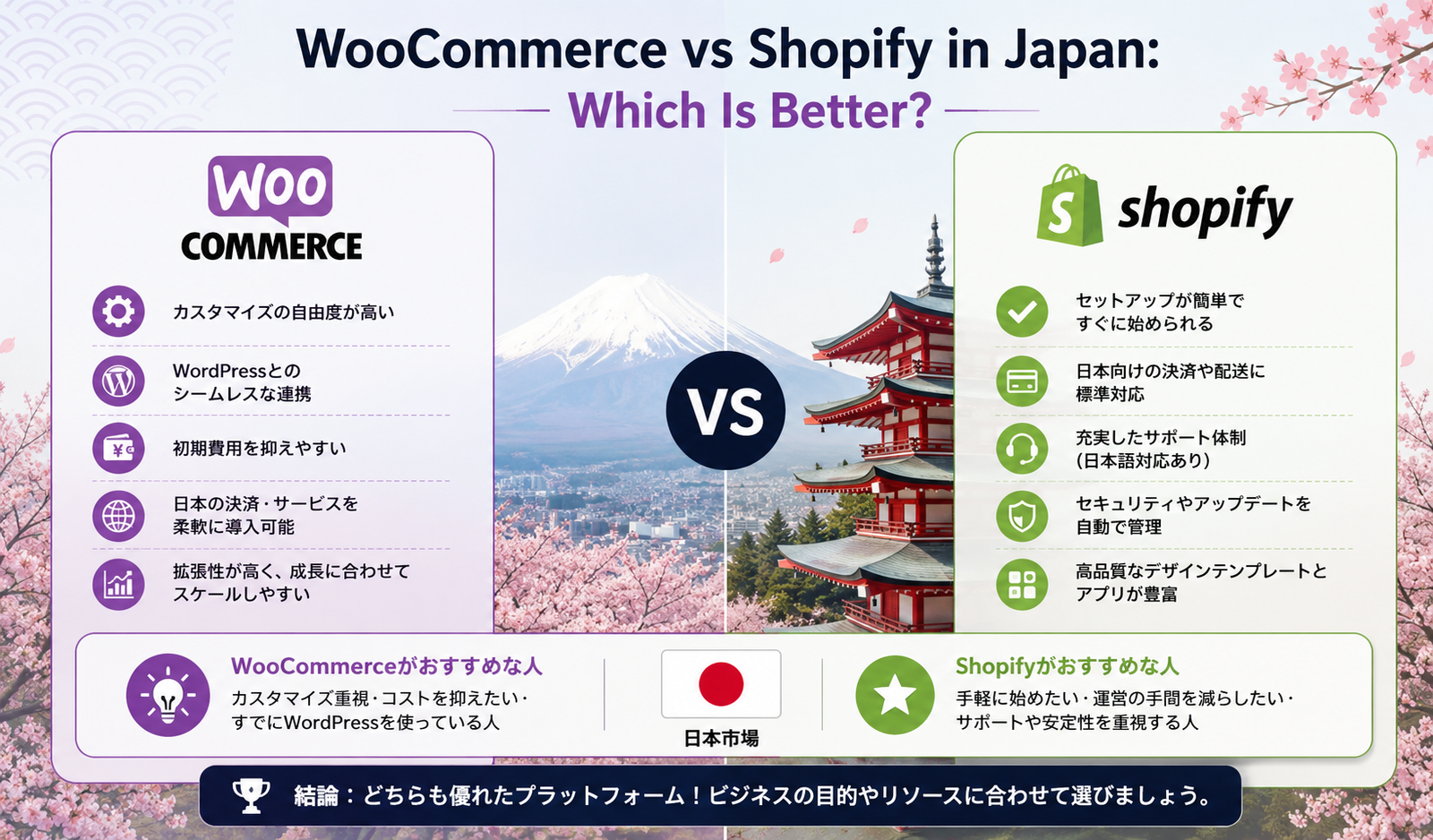
Flexibility is the biggest advantage of using WooCommerce in Japan. Because it is open-source, you can modify the underlying code to accommodate any highly specific Japanese business requirement. If you already run a successful WordPress blog or corporate site, integrating WooCommerce is a logical and straightforward next step.
From a cost perspective, WooCommerce is free to download and install. You only pay for your web hosting, domain name, and any premium plugins you choose to add. This structure often makes it a more cost-effective option for businesses with tight monthly budgets.
The WordPress community in Japan is massive. You will find a wealth of Japanese-language resources, forums, and local developers ready to help you customize your store. There are also specific plugins, like “Japanized for WooCommerce,” designed to automatically format checkout fields for Japanese addresses and integrate with local payment gateways.
Weaknesses of WooCommerce
With great power comes great responsibility. Because you host WooCommerce yourself, you are entirely responsible for security, backups, and software updates. If a plugin update breaks your site, you must fix it yourself or hire a developer.
Localizing WooCommerce can also be a more manual process compared to Shopify. While plugins exist to help adapt the platform for Japanese shoppers, piecing together the right combination of tools takes time and technical know-how. Setting up specific local shipping rules and finding reliable plugins for alternative payment methods often requires extensive testing.
Key Feature Showdown
To make the best decision, let us compare how these platforms handle three critical aspects of selling in Japan.
Payment Gateways
Japanese shoppers utilize a diverse array of payment methods. While credit card usage is growing, Konbini payments remain incredibly popular. Shoppers order online, receive a code, and pay in cash at a local convenience store like 7-Eleven or FamilyMart.
Shopify handles this beautifully through integrations with local providers like Komoju and Paidy. You can activate these options with just a few clicks. WooCommerce also supports these gateways, but the setup process typically requires manually configuring API keys and testing the integration thoroughly to ensure compatibility with your specific WordPress theme.
Language and Localization
Shopify’s backend is fully translated into Japanese, making it easy for local staff to manage inventory and process orders. Many premium Shopify themes also support Japanese typography natively, ensuring your site looks professional.
WooCommerce relies heavily on the WordPress ecosystem for translation. While the core WooCommerce plugin is translated, you may find that certain third-party extensions are only available in English. You might need to use translation plugins like WPML or Loco Translate to ensure every button and notification on your site reads naturally to Japanese consumers.
Shipping and Logistics
Japan’s delivery services are legendary for their punctuality. Customers often select specific delivery dates and time slots during checkout.
Shopify offers excellent apps like Ship&co, which integrates directly with Yamato, Sagawa, and Japan Post to print localized shipping labels and sync tracking numbers. WooCommerce users can also achieve this functionality using dedicated shipping plugins, but Shopify’s app ecosystem generally offers a smoother, more user-friendly interface for logistics management.
Frequently Asked Questions (FAQ)
Which platform is cheaper for a new business in Japan?
WooCommerce generally has lower upfront and recurring costs since the software is free. However, you must factor in the cost of premium hosting, developer time, and paid plugins. Shopify involves a predictable monthly subscription, which some business owners prefer for financial planning.
Can I accept Konbini (convenience store) payments on both platforms?
Yes. Both Shopify and WooCommerce support Konbini payments. Shopify integrates easily through partners like Komoju, while WooCommerce utilizes plugins provided by local payment gateways to achieve the same result.
Is one platform better for SEO in Japan?
Both platforms offer robust SEO capabilities. Because WooCommerce is built on WordPress—originally a blogging platform—it provides deep technical SEO control and integrates perfectly with plugins like Yoast. Shopify also performs exceptionally well in search rankings and offers built-in features to manage meta tags, URLs, and image text.
Making the Right Choice for Your Store
Choosing between WooCommerce and Shopify for your Japanese expansion depends entirely on your business model, technical expertise, and budget.
If you want a streamlined, user-friendly platform that handles technical maintenance for you, Shopify is the superior choice. Its aggressive localization efforts in Japan have resulted in a powerful ecosystem of apps and payment integrations that allow you to launch quickly and scale securely.
If you require absolute control over your store’s design, already utilize WordPress, and have the technical resources to manage your own hosting and security, WooCommerce remains an unbeatable option. It provides the flexibility needed to build a highly customized shopping experience tailored exactly to your Japanese audience.
Evaluate your internal resources, test the interfaces of both platforms, and choose the system that best supports your long-term growth in the Japanese market.